
Constructing a building in Nepal will be one of the largest financial investments that any family would ever make. Regardless of whether you plan to construct a simple two-story building in Pokhara or a luxurious villa in Kathmandu, knowing the true cost of construction before laying the first brick can prevent future regret and unnecessary spending.
This article gives you all the necessary information about the cost of constructing a building in Nepal for the year 2026.
The price per square feet will be charged on total built-up space. For instance, a two-story residential building with average quality construction in Pokhara or Kathmandu in 2026 will cost NPR 80-100 lakhs for an area of 1,500 to 2,000 square feet.
1. Construction cost by finish level (2026)
Based on current market quotes from contractors and consultancies across Nepal, construction cost falls into three broad tiers:
a. Basic / budget
NPR 2,800–3,700 per sq ft
- Simple RCC structure
- Basic tiles (local grade)
- Ordinary doors/windows
- Minimal interior finish
- Standard paint (cement)
b. Standard / medium
NPR 4,000–6,000 per sq ft
- Good RCC + earthquake-safe design
- Better tiles (600×600 or similar)
- Steel/aluminum doors & windows
- Standard electrical & plumbing
- Emulsion or OBD paint
c. Premium / luxury
NPR 6,000–9,000+ per sq ft
- High-end imported tiles/marble
- Modular kitchen & wardrobes
- Aluminum curtain/sliding windows
- False ceiling & decorative lighting
- Branded sanitaryware
2. Interactive cost calculator
Use the calculator below to get a quick estimate for your planned house construction in Nepal.
3. What is typically included (and excluded)?
Contractors usually include the following in their price quote per sq ft but make sure you check against a BOQ before signing any contract.
a. Usually Included
- Standard doors & windows (as per BOQ)
- Foundation + RCC structure (footings, columns, beams, slabs, staircase)
- Masonry (brick/block walls)
- Internal + external plastering
- Basic floor tiles (ground floor)
- Basic paint (emulsion/distemper)
- Basic electrical & plumbing conduits and fixtures
b. Often Excluded
- Soil testing, structural drawings fees
- Compound wall, gate, boundary fencing
- External paving, driveway, landscaping
- Septic tank / soak pit
- Waterproofing (terrace, balcony, sunken slabs)
- Modular kitchen, wardrobes, false ceiling
- Designer lights, premium sanitaryware
4. Detailed rate analysis (per 100 sq ft basis)
The following table shows the rate analysis of a medium standard RCC Residential House in Nepal, considering the area to be 100 square feet. This rate analysis is done on the same pattern as that of DUDBC District-wise Rate Analysis.
| S.N. | Description of work | Unit | Qty | Rate (NPR) | Amount (NPR) |
|---|---|---|---|---|---|
| 1 | Earthwork excavation in foundation | m³ | 0.40 | 1,800 | 720 |
| 2 | PCC 1:3:6 in foundation bed | m³ | 0.12 | 9,500 | 1,140 |
| 3 | RCC 1:1.5:3 (columns, beams, slabs) | m³ | 0.60 | 14,000 | 8,400 |
| 4 | TMT steel reinforcement (Fe 500) | kg | 55 | 98 | 5,390 |
| 5 | Brick masonry in CM 1:4 | m³ | 0.80 | 3,500 | 2,800 |
| 6 | Plastering (internal + external) 12mm | m² | 4.50 | 220 | 990 |
| 7 | Floor tiles 600×600 (1st floor) | m² | 1.00 | 1,200 | 1,200 |
| 8 | Emulsion paint on walls (2 coats) | m² | 3.50 | 180 | 630 |
| 9 | Basic electrical wiring (conduit + fittings) | room | 1.00 | 1,800 | 1,800 |
| 10 | Basic plumbing (pipes + fixtures per room) | room | 1.00 | 1,500 | 1,500 |
| 11 | Doors (timber frame + panel, standard) | no. | 0.50 | 9,000 | 4,500 |
| 12 | Windows (aluminium sliding, standard) | m² | 0.30 | 7,500 | 2,250 |
| 13 | Labor (skilled + unskilled, overhead) | – | – | – | 3,500 |
| 14 | Contractor overhead & profit (10%) | – | – | – | 3,482 |
| Total per 100 sq ft (approx.) | NPR 38,302 | ||||
| Unit rate per sq ft (standard finish) | ≈ NPR 3,830 | ||||
The rate above represents core structural + basic finish items only. Adding premium finishes, modular kitchen, false ceiling, and imported sanitaryware can push the final rate to NPR 5,500–7,000 per sq ft.
5. Cost breakdown by component
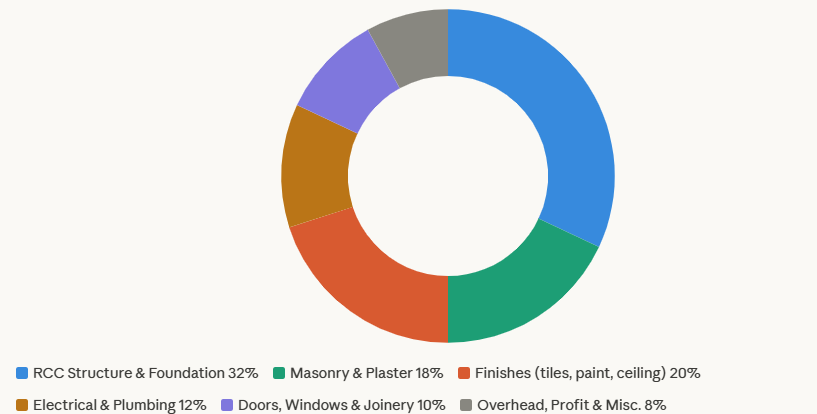
In a standard RCC residential house in Nepal, the cost typically distributes as follows across major components:
6. Current material prices (2026)
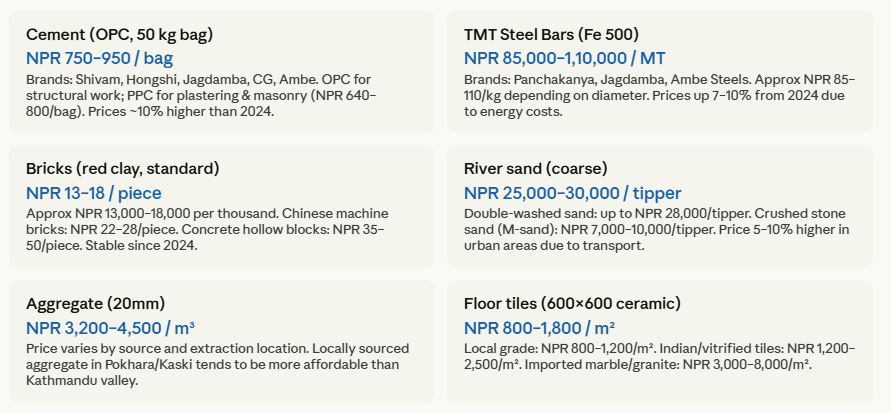
Material cost forms roughly 55–65% of the total construction budget. Here are the current market rates for key building materials in Nepal as of early 2026:
7. Labor wages in construction (2026)
Labor cost typically makes up 25–35% of total construction cost. Nepal’s official minimum wage was revised upward by 13% to NPR 19,550/month effective July 2025. Field rates for construction trades vary significantly by location and season.
| Category of worker | Daily wage (Kathmandu) | Daily wage (Outside Valley) | Daily wage (Rural areas) | Season effect |
|---|---|---|---|---|
| Mason (skilled) | NPR 1,500–2,000 | NPR 1,200–1,600 | NPR 900–1,200 | High Oct–Apr |
| Carpenter (skilled) | NPR 1,200–1,800 | NPR 1,000–1,500 | NPR 800–1,100 | High Oct–Apr |
| Bar bender / steel fixer | NPR 1,200–1,600 | NPR 1,000–1,400 | NPR 800–1,100 | Moderate |
| Plumber (skilled) | NPR 1,200–1,800 | NPR 1,000–1,500 | NPR 800–1,200 | Moderate |
| Electrician (skilled) | NPR 1,200–1,800 | NPR 1,000–1,500 | NPR 800–1,100 | Moderate |
| General helper / unskilled | NPR 800–1,200 | NPR 700–1,000 | NPR 600–800 | Lower Jun–Sep |
Construction Timing: The best period for construction should be from October to February. These months provide a perfect season for construction after the monsoon; labor is relatively cheaper by 10-20% but quality control becomes difficult during the monsoon.
8. Cost comparison by location
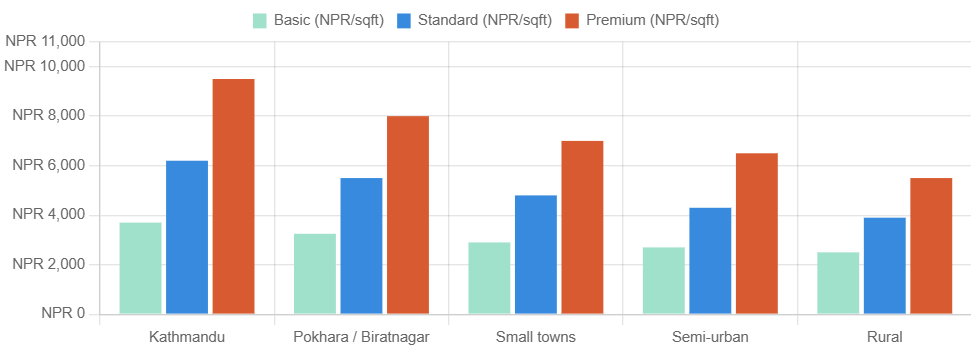
Construction costs in Nepal vary significantly by geography. Here is a comparison of effective cost ranges across different regions:
9. Factors that affect construction cost
a. Finishing level
- Tiles, paint, doors/windows, and sanitaryware alone can add NPR 1,000–2,500 per sq ft between basic and premium levels. This is the single biggest variable in per sq ft cost.
b. Design complexity
- Cantilever balconies, curved walls, double-height spaces, irregular floor plans, and multiple toilets all increase RCC and labor cost significantly. Simple rectangular plans are always the most economical.
c. Location & transportation
- Kathmandu and Pokhara typically cost 10–20% more than rural districts. Remote sites can add 15–30% to material costs due to transport. Access road condition and site logistics matter.
d. Soil & foundation type
- Poor soil, filled land, or high water table may require deeper foundations, pile work, or soil stabilization costs not captured in standard “per sq ft” averages. Always conduct a soil test first.
e. Contract type
- Turnkey lump-sum contracts are convenient but can hide overpricing. Item-rate BOQ contracts give full cost transparency and allow you to verify against DUDBC district rates.
f. Steel & cement brand
- Premium TMT brands (Panchakanya, Jagdamba) cost NPR 10,000–20,000/MT more than locally sourced alternatives. Premium cement brands add NPR 100–200/bag. Do not compromise on structural grades.
10. Tips to control construction cost
- Get a BOQ contract: Detailed Bill of Quantities will keep any surprise out of the equation. Demand item-rate basis and payment according to completion percentage.
- Keep things simple: Don’t opt for cantilevers, curves, lots of rooms, and unconventional roofs. Square/rectangular structures are cheapest and seismically efficient.
- Stage your finish works: Construct first and stage up your tiles, lights, and plumbing fixtures to spread costs. You can make changes due to fluctuating market prices.
- Refer DUDBC: District-wise rate analysis documentation is published by Department of Urban Development and Building Construction (DUDBC). This document acts as a benchmark reference point.
- Test your soil: Geotechnical report will help avoid costly foundation revision later. This is particularly critical where there is filled land or water proximity.
- Always keep a 5–10% margin: Variations, escalations, and other uncertainties will always happen. It’s better to plan ahead for them.
- Start after monsoons: You will have an entire dry season to construct your building. Plus, you will enjoy cheaper materials and ease of site access.
References:
- DUDBC (Department of Urban Development & Building Construction), Nepal — District-wise Rate Analysis, 2082 B.S.
- Dutta, B.N. — Estimating and Costing in Civil Engineering, UBS Publishers.
- Jadan Construction Group — House Construction Cost Guide Nepal 2026.
- Ministry of Labour, Employment and Social Security, Nepal — Revised Minimum Wage Notification, July 2025.
- Nepal Rastra Bank — Inflation and Construction Cost Index, 2025.
- IS 1200 — Method of Measurement of Building and Civil Engineering Works, BIS.
- Punmia, B.C. — Estimating and Costing, Laxmi Publications.